THE KINGS OF THAI BOXING WITHOUT CROWNS

THE KINGS OF THAI BOXING WITHOUT CROWNS
by Serge TREFEU (2026)
From the 1970s until the early 2010s, in Thailand, the ultimate goal for any Muay Thai champion was to win a belt in one of Bangkok’s most prestigious stadiums: Lumpinee Boxing Stadium or Rajadamnern Stadium. To a lesser extent, belts from Channel 7 Stadium and Omnoi Stadium also represented a significant achievement.
Becoming champion of Lumpinee or Rajadamnern (the Rajadamnern Stadium’s nickname) was tantamount to being crowned world champion, the best Muay Thai fighter in one’s weight class. It was the absolute benchmark, the culmination of a career.
Today, Muay Thai has evolved considerably in Thailand, and Bangkok’s two largest stadiums no longer enjoy the exceptional prestige they possessed for over forty years.
The Covid-19 pandemic profoundly disrupted the Muay Thai scene. It notably led to an unprecedented opening of a historically very closed world in Thailand, allowing many foreign fighters to access major national stages.
At the same time, the ONE Championship organization established itself as the undisputed media benchmark, capturing the public’s attention and redefining the criteria for recognition. Today, for many, the true champions of Thailand are primarily those who have won a ONE belt.
Purists, however, remain attached to the traditional titles from the major stadiums, particularly those of Rajadamnern Stadium, Channel 7 Stadium, and Omnoi Stadium.
It is regrettable that no belt from the legendary Lumpinee Boxing Stadium is currently up for grabs, as it represented, at its peak, the most prestigious distinction in Muay Thai.
However, the Rajadamnern Stadium and Channel 7 Stadium belts remain extremely coveted by Muay Thai enthusiasts, and even more so in the highly influential world of sports betting.
Being champion of Lumpinee Boxing Stadium or Rajadamnern Stadium is undoubtedly a major achievement. Nevertheless, it doesn’t necessarily mean being the best of the best.
The history of Muay Thai is full of exceptional fighters who dominated their weight class during the golden age of Bangkok’s stadiums, particularly in the 1970s, 80s, and 90s, without ever managing to win one of these legendary titles.
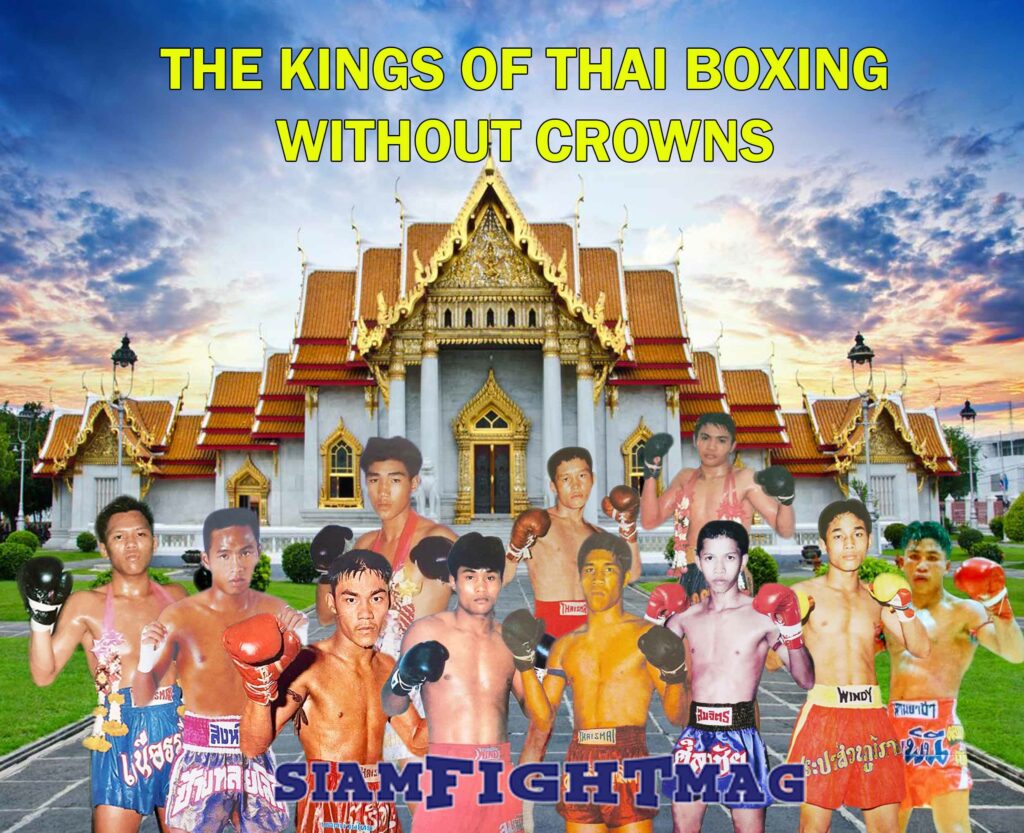
They reigned supreme in their division, impressed connoisseurs, and thrilled the crowds… without ever being crowned champion. True kings of the ring without crowns…
They are numerous, but among the most iconic are:
1970s: Huasai Sittiboonlert, Posai Sittiboonlert, Neth Saknarong
1980s: Krongsak Sakkasem, Changpuek Kiatsongrit, Youssop Sor Thanikul
Golden Age of the 1990s: Nuathoranee Thongraja, Pongsiri Por Ruamruedee, Somrak Khamsing, Silachai Vor Preecha, Singdam Or Ukrit, Rambo Jiew Por Thapthim
Their legacy sometimes surpasses that of certain titled champions. Because in traditional Muay Thai, a fighter’s worth is not measured solely by a belt, but also by the quality of their opponents, their true dominance, and the mark they leave on the memories of connoisseurs.
1970s:
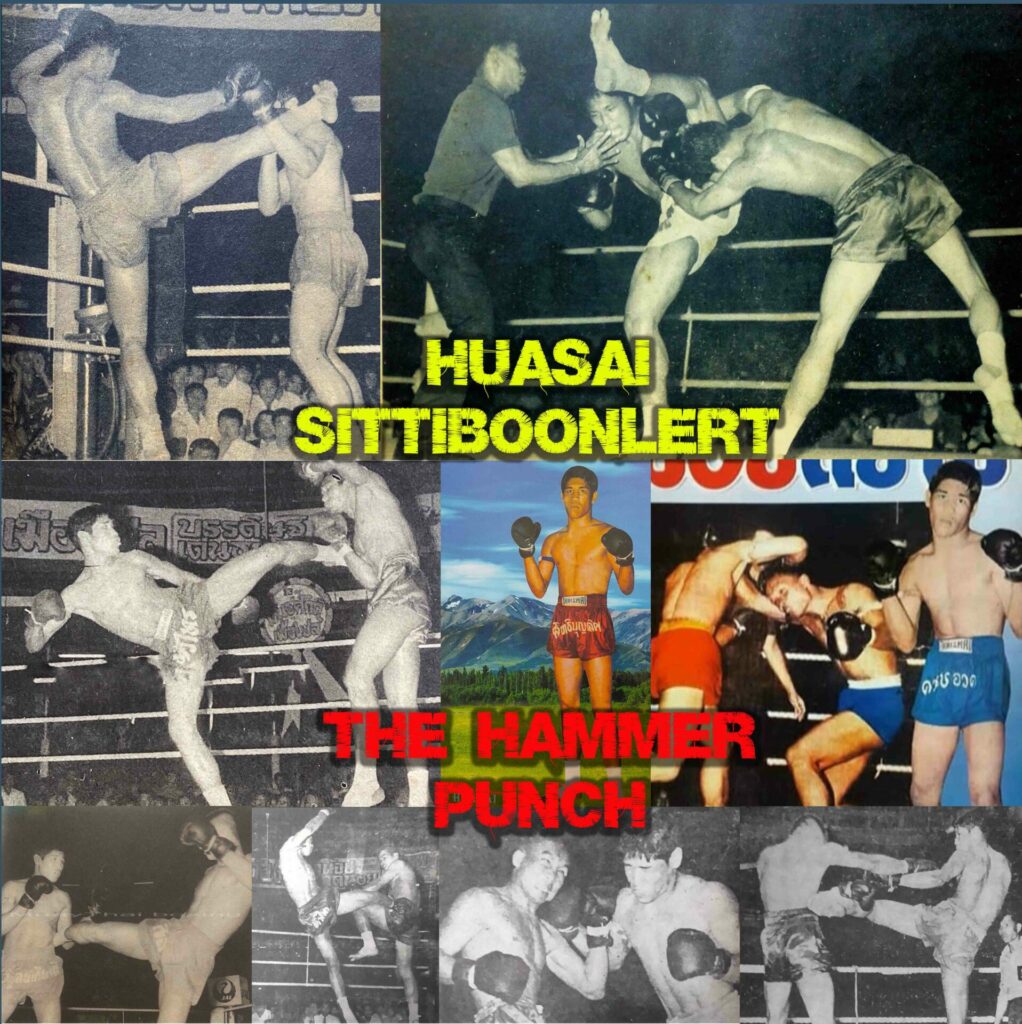
Huasai Sittiboonlert, born Suracheep Rakthong, was born on June 15, 1948, in Huasai, in the southern province of Nakhon Ratchasima. At the age of 15, he began training in Muay Thai under Jaresak Kor Pholyuth. After a relatively short period, he made his ring debut in his hometown, fighting under the name Sathansamut Singhamanee. He fought more than ten bouts there, laying the foundation for his career.
He was then spotted by Nakhon Kongchuen, who took him into his stable and brought him to fight in Bangkok. It was there that he changed his name to Hua Sai Singh Muang Nakhon. Later, Nakhon entrusted him to Boonkiat Wiboonlap’s “Jom Sai Krok” camp, marking another turning point in his career. He then definitively adopted the name Hua Sai Sitthiboonlert.
A talented and versatile fighter, Huasai initially distinguished himself with the effectiveness of his kicks and knees. Over time, he refined his boxing and developed formidable punching power, becoming a feared knockout artist who racked up numerous victories. His exceptionally powerful right punch earned him the nickname “The Hammer Punch.”
In the 1970s, he established himself as one of the best light heavyweight boxers of his generation. He notably achieved significant victories against renowned opponents such as the legendary Apidej Sitthiboon, whom he knocked out, and the star Vicharnoi Porntawee.
Huasai was long ranked number one in the 140-pound weight class at Lumpinee Stadium and Rajadamnern Stadium, although he never officially won a title in these prestigious Bangkok arenas.
He later attempted a brief career change to boxing, without significant success, managing only victories against weak opponents. He did, however, get the opportunity to fight for the world super lightweight title (63.5 kg) against Filipino boxer Pedro Adigue, but lost the bout.
After ending his boxing career, Huasai worked for many years as an extra in Thai cinema during its golden age. He also briefly served as the head coach at the renowned Kiatbanchong boxing camp in Bangkok.
Eventually, he left the world of boxing and returned to his hometown of Huai Sai. There, he began a new professional life as a real estate agent, while also managing several hectares of shrimp farms.
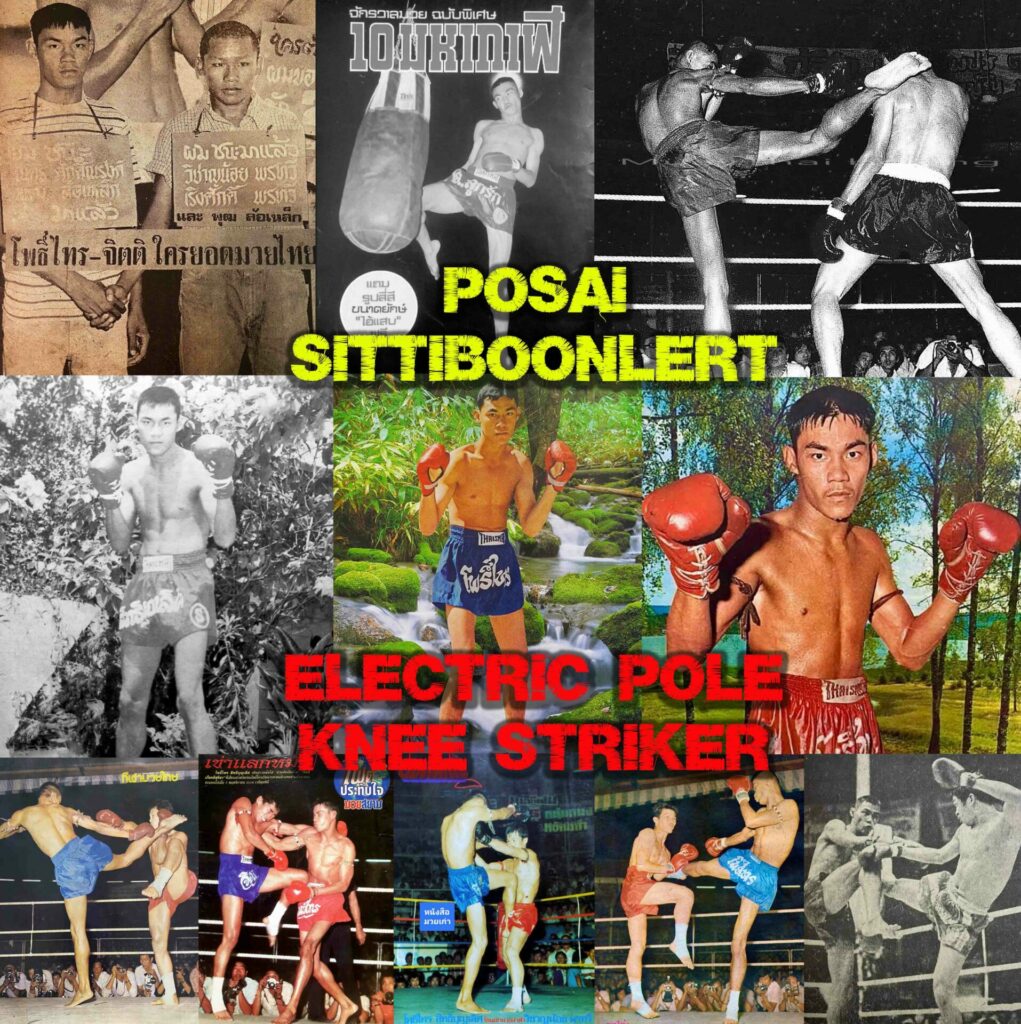
Hailing from the same camp as Huasai, Posai Sittiboonlert, whose civilian name is Prayong Makkhong, was born on February 12, 1956, in Taklee, Nakhon Sawan Province.
A pure Muay Khao fighter, Posai distinguished himself by the extreme power and effectiveness of his knee strikes. This style, feared in the ring, earned him the nickname “Electric Pole Knee Striker.”
A true terror of his generation, Posai dominated the 135-pound weight class at Lumpinee Stadium for many years, though he never officially won the title.
On Friday, May 14, 1976, at Lumpinee, he faced the great champion Wichit Lukbangplasroi, then the stadium’s titleholder.
The favorite before the fight, Wichit was subjected to a veritable deluge of kicks and knees from Posai in the opening rounds, to the jeers of a divided crowd. The referee stopped the fight in the final round, citing an alleged “lack of fair play.” The match was declared a “no contest,” a decision as controversial as it was unfair for Posai, who saw the title slip through his fingers.
In the rematch, Posai managed to defeat Wichit, but this time without the Lumpinee belt being on the line.
He then earned a second chance to conquer a major title. On Thursday, July 15, 1976, at Rajadamnern Stadium, he faced the legend nicknamed “The Immortal Boxer,” Vichannoi Porntavee, the reigning 140-pound champion.
Against this formidable champion, Posai delivered a courageous performance but ultimately lost on points.
Throughout his career, Posai secured numerous prestigious victories against prominent figures of the era, such as Poot Lorlek, Sakad Petchyindee, Somsak Sor Tewasunthorn, Poomsiri Rungrit, Khaosod Sitpraprom, Seksan Sor Theppitak, and Neth Saknarong. He also delivered a resounding knockout to the great Dutch kickboxing champion, Ron Kuyt.
In 1977, he achieved a now-famous feat by facing two top-level opponents in the same fight, first, Rajadamnern star Jocky Sitkanpai, and then champion Jitti Muang Khon Kaen. Posai won this marathon bout on points.
That same year, at Lumpinee Stadium, he faced three Japanese fighters in a single match. After dominating Futoshi for two rounds, he knocked out Asano in the third round, then Kentosa in the fourth, concluding an exceptional performance.
The excellence and consistency of his performances earned him the title of “Best Boxer of the Year” in 1976, one of the most prestigious awards in Muay Thai.
After retiring from his fighting career, Posai continued his involvement in the world of boxing by becoming a coach, sharing his knowledge and experience in several Muay Thai camps.
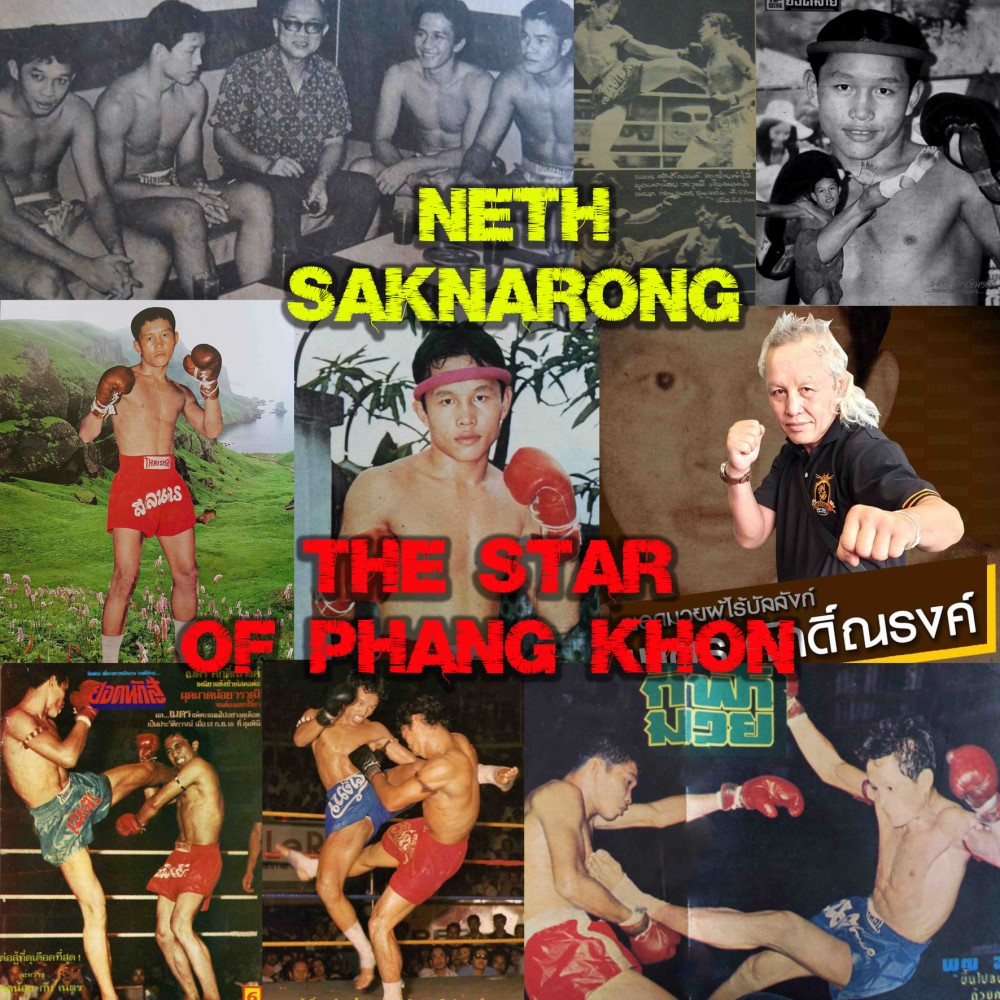
Neth Saknarong, whose real name is Viraneth Nakainn, was born on November 6, 1955, in Phang Khon, Sakon Nakhon region, Thailand.
He was nicknamed “Daodan Phang Khon” (The Star of Phang Khon) by Muay Thai fans.
Neth Saknarong is one of the few boxers to have defeated several legends of the ring, including Pud Pad Noy Worawut (Lumpinee champion, named Boxer of the Year in 1975, recognized as one of the ten greatest fighters of all time, and inducted into the Hall of Fame as the “Legends Trophy” in 2014), Poot Lorlek (Lumpinee champion, Boxer of the Year 1974, Hall of Fame 2014), Wicharnoi Porntawee (Lumpinee champion, Boxer of the Year 1977, Hall of Fame 2014), and Posai Sitiboonlert (Boxer of the Year 1976).
He also achieved a knockout victory against the renowned Full Contact and Karate champion Earnest Heart in Los Angeles, USA, in 1977.
Although he never won a major title, Neth Saknarong held the top spot in Bangkok’s two largest stadiums, Lumpinee and Rajadamnern, for several years.
After his fighting career, Master Neth arrived in France in 1988 to fight at a gala organized by singer Jean-Luc Lahaye. There, he knocked out European champion Mustapha Benatia.
He then settled permanently in France and, in 1995, founded his own gym, Neth Gym, in Val-de-Reuil, Normandy, where he still teaches today.
Master Neth is the father of a daughter born in France, who is now 14 years old. He became a highly respected coach, having trained several champions, including the remarkable technician Karim Saada (European champion, six-time French champion, and two-time amateur world champion). Saada defeated some of the sport’s biggest names, such as Fabio Pinca, Youcef Totof, Mustapha Ziani, and the legendary Rajasak Sor Vorapin, three-time Rajadamnern champion.
He also trained light heavyweight Stéphane Gomis, a two-time French champion and silver medalist at the 2007 WMF Amateur World Championships, and prepared the great champion Fabrice Payen for his fights at the Rajadamnern Stadium in the 1990s.
1980s:
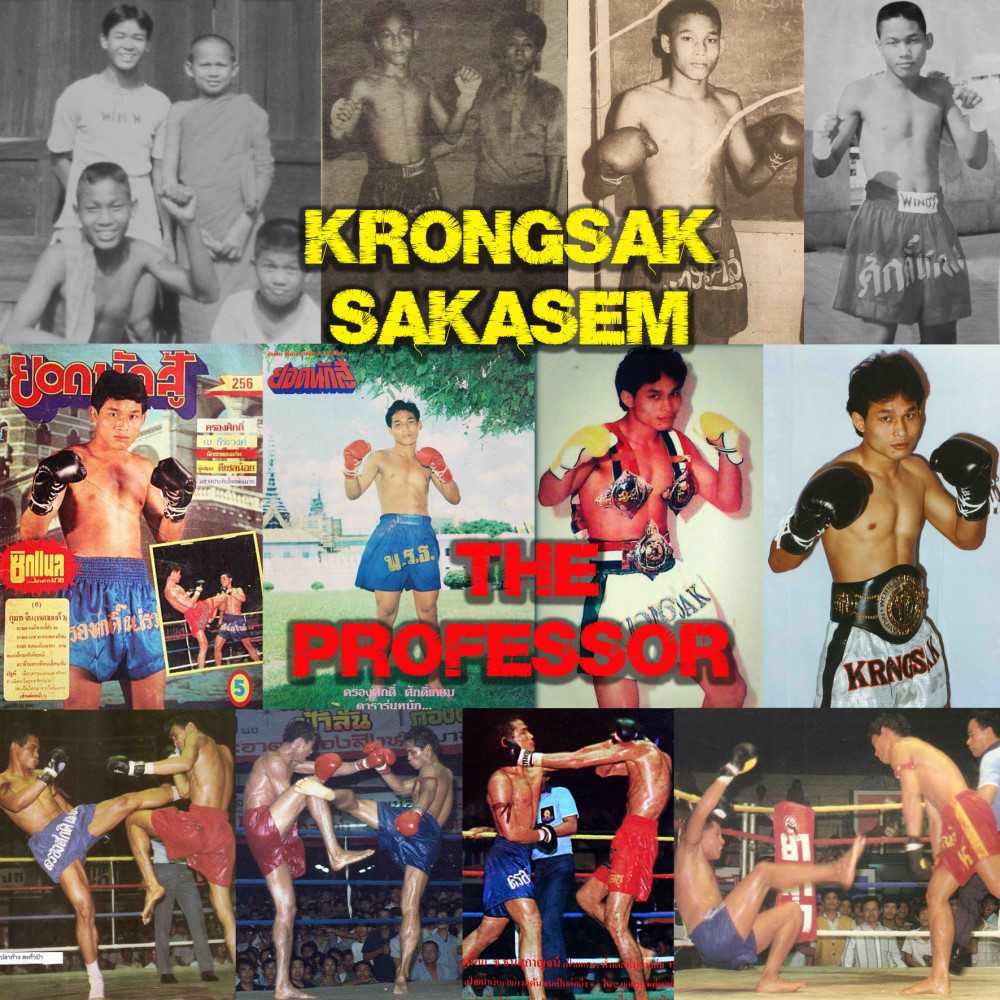
Krongsak Sakacem, whose real name is Prakong Boranrat, was born on September 11, 1963, in the village of Tha Sala, near the city of Nhongrua, in Khon Kaen province, northeastern Thailand.
Muay Thai fans in Thailand nicknamed him “Nakrop Wat” (The Temple Warrior) because he learned to box at a Buddhist temple. He was also known as “Young Fighter from Nhongrua.” Later, when he fought in Europe, he received the nickname “The Professor,” in recognition of his exceptional technical mastery of Muay Thai.
Krongsak is a true legend of the ring. He fought nearly 300 bouts and was a six-time world Muay Thai champion, followed by a three-time world kickboxing champion during his second career in Europe. In Thailand, however, he never won a title at a major Bangkok stadium, although he was, for a time, number one at the capital’s two largest stadiums.
On Tuesday, July 22, 1980, at Lumpinee Stadium, Krongsak fought for the 122-pound title against the reigning champion, the great Lom Isaan Sor Thanikul (Lumpinee 122-pound champion and Rajadamnern 126-pound champion). Thanikul won by knockout in the fourth round with a high kick to the back of the neck.
Lom Isaan was nicknamed “Left Kicker from the North East” because of the devastating power of his left high kick. He had defeated many great champions such as Fanta Petchmuangtrat (KO), Wanphadet Sakhroumay (three times), Nokweed Dawee (three times), and Jack Kiatniwat. At the time, Lom Isaan was 24 years old and possessed far more ring experience than the young Krongsak, who was then 16.
On Tuesday, November 3, 1981, again at Lumpinee Stadium, Krongsak faced the formidable puncher Raengsak Petchyindee (Porntawee). Nicknamed “Manut Hin” (The Stone Man), Raengsak was a ferocious striker. At 25 years old, he was the Lumpinee 130-pound champion and defended his title against Krongsak, who was only 17. Raengsak knocked Krongsak out in the first round.
Krongsak was truly unlucky in his two attempts to win the title at the legendary Lumpinee Stadium, losing by knockout each time. He thus never had the opportunity to win a belt in a major Bangkok stadium, despite having defeated numerous champions of his era, many of whom held the Lumpinee or Rajadamnern titles.
He notably defeated the legendary Sagat Petchyindee (Lumpinee and Rajadamnern champion) three times, as well as Samart Prasarnmit (Rajadamnern champion) three times, including one victory by knockout.
He also won against the legends Jitti Kiatsuriya (Best boxer of the year 1977) and Padetsuk Pisanurachan (Best boxer of the year 1979), as well as against the champions Rakchat Sor Prasaporn (Champion of Radja), Raktae Muangsurin (Champion of Radja), Inseenoi Sor Thanikul (Champion of Radja), Jomtrai Petchyindee (Radja Champion), Fanta Attapong (Radja Champion), Somsong Kiatoranee (Radja Champion), Changpuek Kiatsongrit (world champion), Mapralong Sit Por Tor Thor (Lumpinee Champions) and Kaopong Sitichuchai (Lumpinee Champions).
Krongsak also fought two memorable fights against the star of the time, Dieselnoi Haa Phalang. In their first encounter at Rajadamnern Stadium, the judges awarded a draw, while the majority of the crowd saw Krongsak as the winner, provoking the anger of the bettors, who nearly rioted.
In the rematch at Lumpinee Stadium, Dieselnoi won on points after opening a cut in Krongsak’s face with an elbow strike. Krongsak then embarked on a second career in Europe, where he was never defeated.
There, he notably beat the Dutch star Rob Kaman in France, despite a 9-kilogram weight disadvantage, as well as top foreign champions such as Rick Varthorst, Orlando Wiet, Ivan Hyppolite, Stéphane Nikiéma, Guillaume Kerner, André Panza, and Pascal Scalp. Now a coach in France, he has been passing on his vast knowledge to his students for over 30 years.
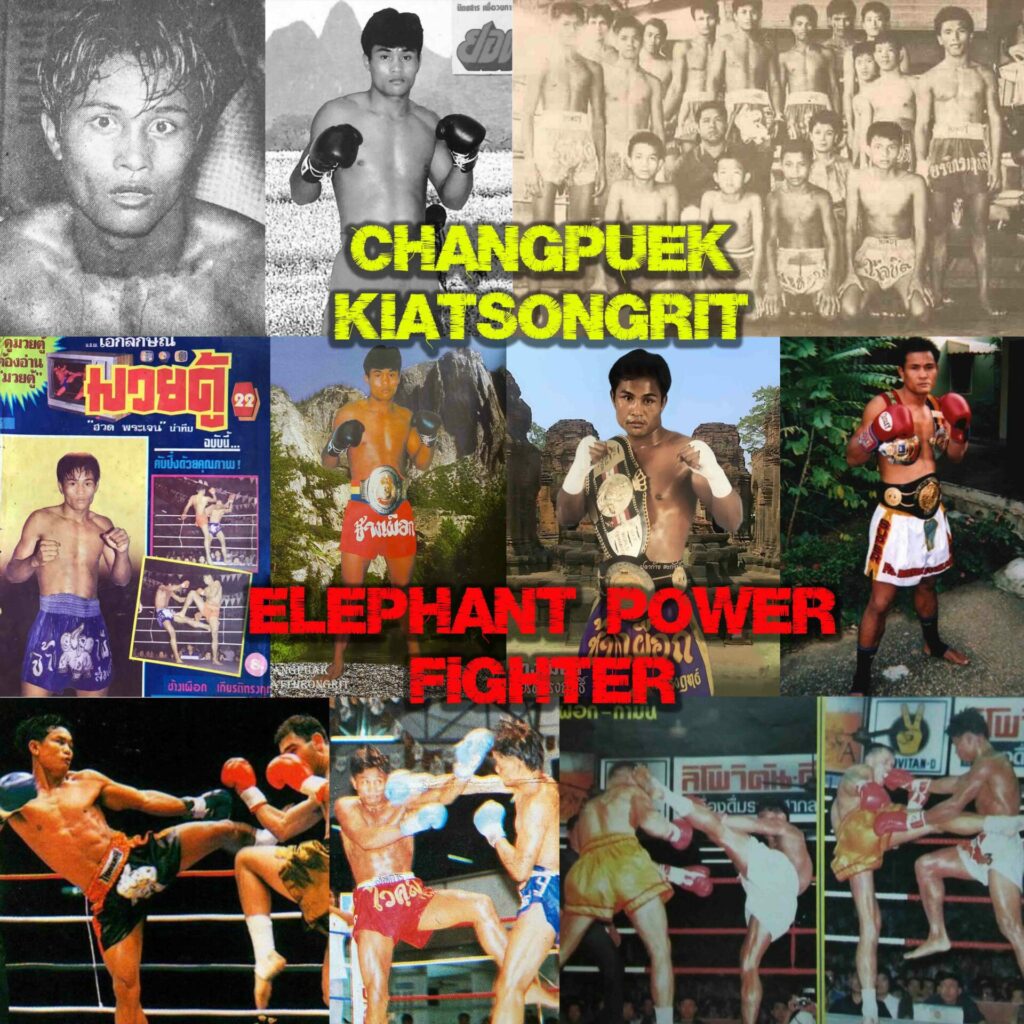
The phenomenal Changpuek Kiatsongrit, whose real name is Somchai Robpantha, was born in 1966 in the Prakhon Chai district of Buriram province, Thailand.
He was nicknamed the “Elephant Power Fighter” due to his impressive physical strength and extraordinary tenacity. Changpuek made Muay Thai history by becoming the first Thai boxer to compete in a K-1 heavyweight tournament in Japan, despite weighing only 75 kg. This challenge against true kickboxing giants highlighted his courage and exceptional performance.
He began boxing at the age of 14 after joining the Kiatsongrit camp in Bangkok. He initially fought in the 108-pound category at Rajadamnern Stadium before moving up to the senior division, where he quickly rose to the Thai heavyweight division (under 75 kg). In Thailand, Changpuek Kiatsongrit faced and defeated the best fighters of his era, including Payap Premchai (KO), Den Muangsurin, Songwanlek Kietpetch (KO), Samart Prasarnmit, Krongsak Boranrat, and Raktae Muangsurin.
Despite these prestigious victories, he never had the opportunity to fight for a title in a major Bangkok stadium.
His fighting style, characterized by devastating low kicks and exceptional resilience, allowed him to stand out and compete internationally against renowned fighters. Changpuek fought in numerous countries, including the United States (Las Vegas), Japan, Australia, the Netherlands, and France. There, he achieved significant victories against several major international figures, further solidifying his global reputation.
Among his most notable achievements are victories over Rob Kaman, Rick Roufus, Stéphane Nikiéma, Orlando Wiet, Tasis Pedritis, Luc Verheyen, Dale Cook, and Peter Smit. A true Muay Thai legend, Changpuek Kiatsongrit won numerous prestigious world titles throughout his career. He was a WMK World Heavyweight Champion, an IMF, UKF, and IMTF World Light Heavyweight Champion, and a WMTC World Light Heavyweight Champion, and competed in nearly 500 fights.
After retiring from the ring, Changpuek worked as a Muay Thai coach at several boxing camps in Pattaya.
Today, he has returned to where it all began, at Kiatsongrit Gym, where he serves as head coach, continuing to inspire and train the next generation of fighters.
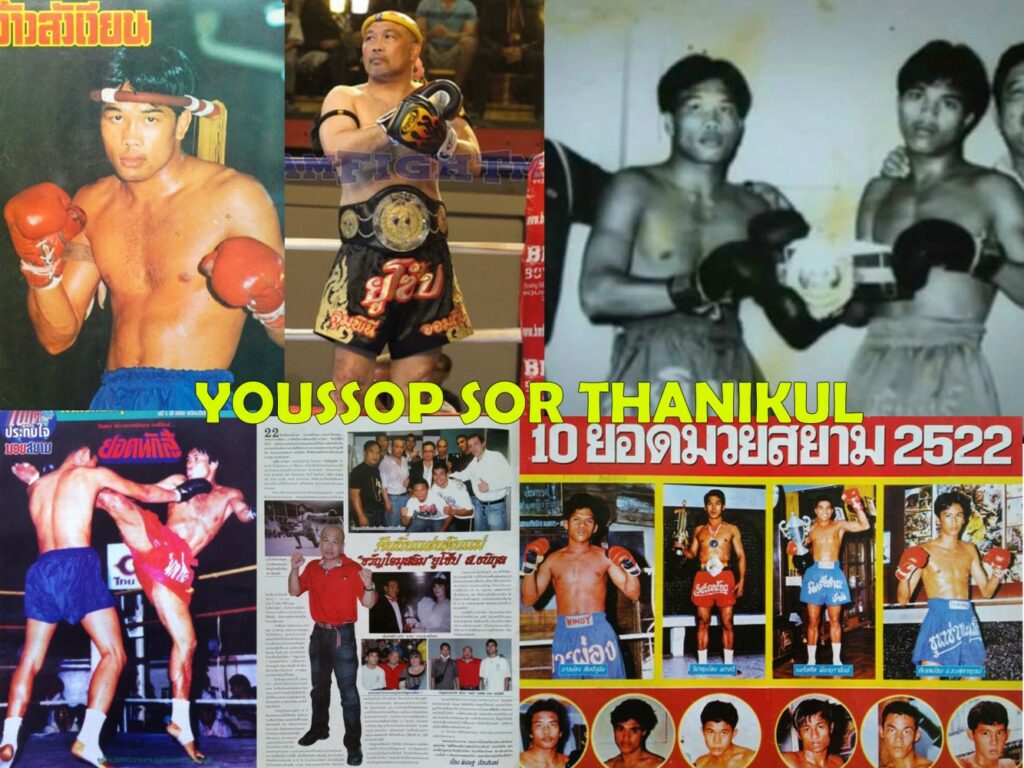
Youssop Sor Thanikul began boxing in 1971, at the age of 13, at the Bangkok gym of the father of the former president of the WPMF federation. He would then fight for almost his entire career at Sor Thanikul Gym, one of the most prestigious Muay Thai gyms in Thai history.
In Thailand, Youssop had 185 fights, with 120 wins, 58 losses, and 7 draws. He primarily competed in the 61.5 kg weight class, which was the most competitive in the 1980s.
At that time, facing the stars of this division meant earning very large purses. Youssop fought twice for the Rajadamnern belt in the -61.5 kg category, but failed to capture the title. He then decided to move up a weight class to face the champions in the -63.5 kg category. In the lightweight division, Youssop remained undefeated, becoming a true force to be reckoned with in the ring, feared by many boxers.
For four years, Youssop was ranked number one in the capital’s two largest stadiums, Lumpinee and Rajadamnern. He unfortunately didn’t get the opportunity to fight for a Lumpinee or Rajadamnern title in the -63.5 kg weight class, but he still managed to capture the WPMF world championship belt in that division.
Youssop defeated numerous renowned champions, such as Samart Prasarnmit (Rajadamern champion), Nakhornsavan (Rajadamern champion), Rakhchat (Rajadamern and Lumpinee champion), Prayap (Lumpinee champion), Wankeo (Lumpinee champion), Seepreh (Rajadamern champion), and Tawalorh (Rajadamern champion).
In Thailand, Youssop also defeated Somsong, the terror of French boxers in the 1980s. He beat the “Lumberjack” at his own game and knocked him out in the third round with devastating low kicks.
One of his finest performances remains his victory against the legendary Jocky Sitkanpai (Rajadamnern champion) in 1980. This fight took place at Lumpinee Stadium, in front of a sold-out crowd, on the same day as the main event between Dieselnoi Chor Thanasukarn and Wicharnoi Porntawee. The stadium was packed, and due to lack of space, some spectators had to sit on the floor. This was the only time in Muay Thai history that spectators found themselves sitting on the floor at Lumpinee Stadium. During this event, Youssop won the Prime Minister’s Cup for the most brutal fight of the evening.
The year 1980 was the most successful of his career. After defeating several top champions, Thai sports authorities ranked him among the top 10 boxers of the decade, where he held fifth place.
Youssop arrived in France in 1987 to begin a second career in Europe. Despite an exceptional career in Thailand, he was no longer the formidable fighter of his heyday. He wasn’t at his peak and was suffering from a serious injury, a broken tibia. Despite this, he faced and defeated several top European champions.
In Europe, Youssop fought seven times, two in the Netherlands and five in France, before becoming one of the most renowned trainers in France. He didn’t train seriously for his fights in France, as he worked nights all week. Despite these difficult conditions, he defeated Fabrice Payen (world and European champion), Mustapha Benattia (European champion), and Bruno Benlabed (European champion).
He lost on points to European champion Pascal Scalp. His last fight took place in 1989 against the rising young champion of the time, Stéphane Nikiéma (world and European champion), who defeated him by knockout.
Youssop settled permanently in France. In 1990, he married a French woman, and in 1991, a son named Anthony was born. Youssop already had two children in Thailand from a previous marriage.
For 30 years, Master Youssop shared his vast knowledge. An excellent coach, his invaluable advice was always listened to attentively by the boxers, even in their corners during fights. The champions of the famous Phénix Muay Thai club, Farid Villaume, Karim Saada, Djamel Yacouben, Pascal Benmati, Mamadou Diabira, Franck Nadje, Madgid Temar, the Defretin brothers, Desty Beaubrun, Karl Dubus, Laetitia Bakissy, Samy Sana, Vatsana Sedone and Sidy Koné, have all switched to pad work with this Muay Thai perfectionist.
1990s:
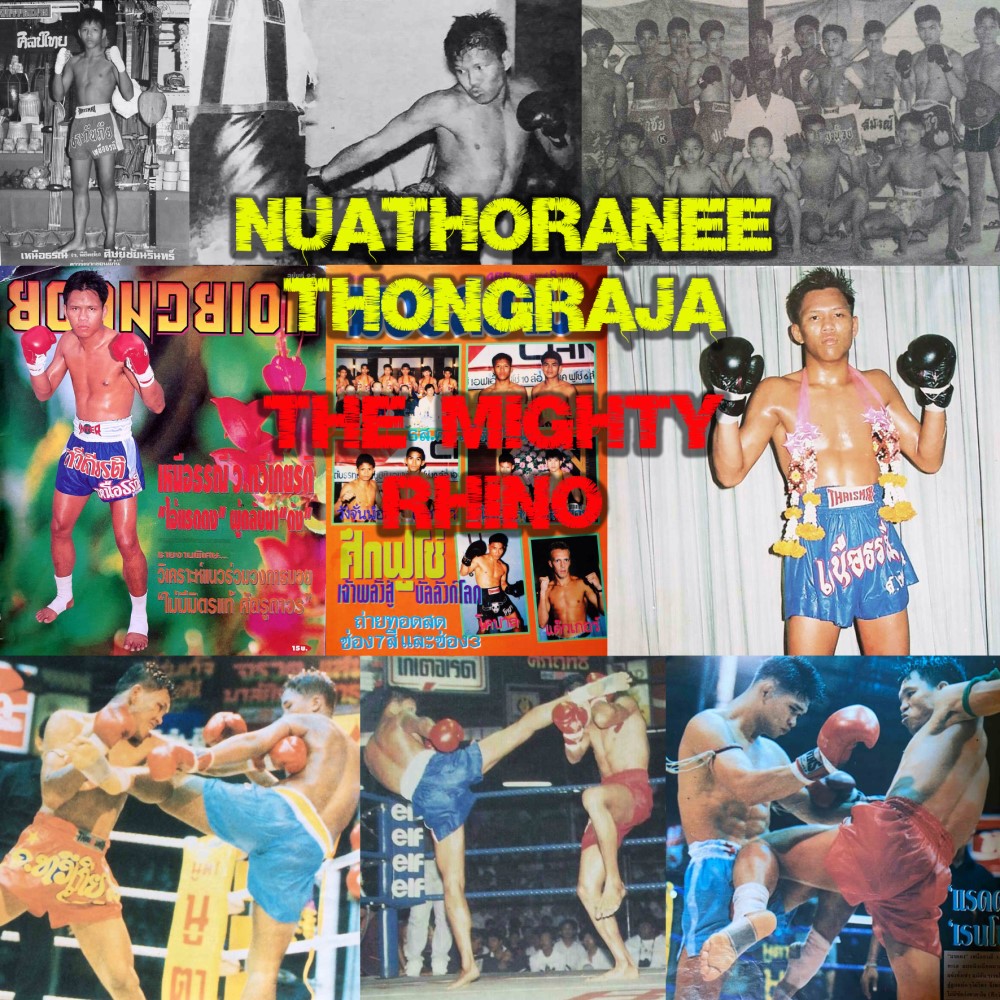
Nuathoranee Thongraja was born on October 25, 1971, in Ban Phaï, Khon Kaen Province, in northeastern Thailand.
Trained at Wor Thaweekiat Gym and later under Mr. Thongraja, Nuathoranee also fought for Master Yodtong, the owner of Sityodtong. He had many extremely violent fights. A true powerhouse, he had mastered elbow strikes.
He often ended his fights with cuts to the face, both for himself and his opponents. This was notably the case during his bout against Matee Jedipitak at Rajadamnern Stadium in 1994, where both fighters ended up with bloodied faces (Matee Jedipitak won).
His fight against the formidable Den Muangsurin in 1993 was also a very bloody match, won by Nuathoranee by referee stoppage. Nuathoranee was nicknamed “Ay Ret Dong” (The Mighty Rhino) by Muay Thai fans.
He was ranked number one at Lumpinee Stadium several times, but never managed to win a title at a major Bangkok stadium. He notably fought for the Lumpinee 130 lbs title against star Namkabuan Nong Kee Pahuyuth, who won by decision.
Despite this, Nuathoranee defeated virtually all the top champions of his generation, including Sangtiennoi Sor Rungroj, Den Muangsurin (TKO), Ritthichai Lookchaomaesaitong, Pomphet Naratreekul, Pairoj Wor Wirapon (KO), Jongsanan Fairtex, Ankaradech Por Pao In, Rajasak Sor Worapin, Chodchoy Chuchokchay, Pomphet Naratrikul, Wangchanoi Sor Palangchai, and Jaroenthong Kiatbanchong.
After his fighting career, Nuathoranee went to coach at a gym in Japan.
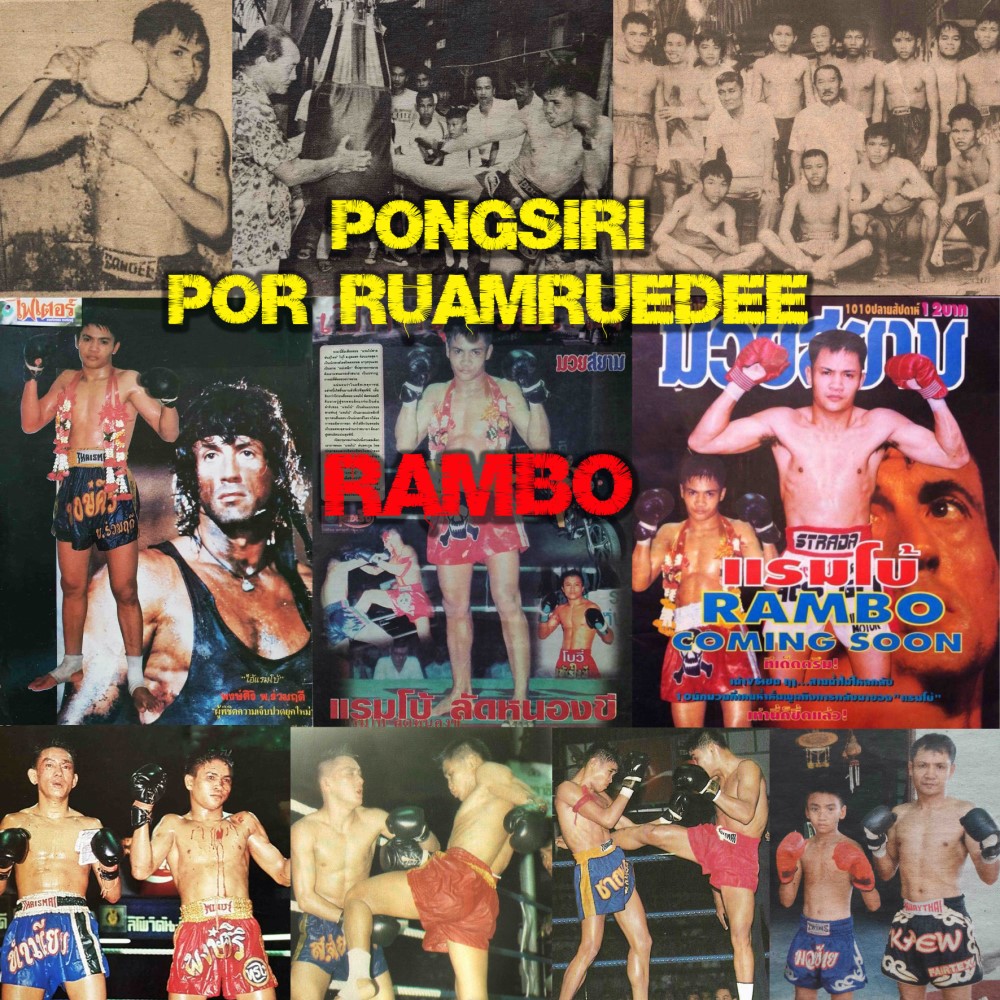
Pongsiri Por Ruamruedee, whose real name is Phayboun Ladnongkhi, was born in 1967 in Thaleang, Nakhon Ratchasima province, in northeastern Thailand.
He trained at the Charoenmuang gym, originally located on Charoen Muang Road in Bangkok. The gym changed locations several times before settling permanently on Soi Ruamruedee, near Lumpinee Stadium. The Charoenmuang Gym boasted many great champions among its ranks, including Saknoi Charoenmuang (Rajadamnern champion), Weeranoi Charoenmuang, Sompong Charoenmuang, Thongbai Charoenmuang, and Choochai “Rambong” Kiatchartsingh.
Pongsiri was nicknamed “Rambo” because of his extremely aggressive boxing style, comparable to that of a mercenary soldier storming the ring. A true juggernaut, he was a tank, relentlessly advancing on his opponents.
“Rambo” was a real terror in the 112 lb and 115 lb weight classes. Many fighters feared him. He entered the ring with a pirate flag to intimidate his opponents, a black flag adorned with a white skull and crossbones, a symbol he also sported on his robe and shorts. Pongsiri Por Ruamruedee never won a belt in Bangkok’s major stadiums, but he was the long-time number one at Lumpinee Stadium, facing all the top fighters in his weight class.
His most formidable opponent was Pairojnoi Sor Siamchay. Their clashes always resulted in legendary fights. These two “Muay Bouk” (fighters who constantly advance) faced each other three times. In 1988, their first fight ended in a draw. Pongsiri then won the second fight, before Pairojnoi took his revenge on points the following year.
On November 4, 1988, at Lumpinee Stadium, the rematch between Pongsiri and Pairojnoi drew a record purse of 3 million baht, a first in the history of Muay Thai.
This fight was incredibly intense. Both fighters pushed themselves to their limits, both suffering cuts to the face and covered in blood, nearly requiring medical attention several times. They fought until the final minute of the fifth round, and Pongsiri ultimately won on points. Both men ended up exhausted in the hospital.
This exceptional match was voted “Fight of the Year” and designated as the toughest fight of the last twenty years, even receiving the nickname “Fight of the Century.” During his career, Pongsiri defeated the best champions in his weight class, including Chainoy Muangsurin, Pichit Sitbangprajan, Morakot Sor Thamrangsee, Hippy Singmanee, Seksan Sitjomthong, Pairojnoi Sor Siamchay, Toto Por Pongsawang, Nungubon Sitlerdchai, and Langsuan Phayutaphum.
He also defeated foreign champions, including the formidable Dutchman Michael Lieuwfat, as well as the great French champions Jaid Seddak and Khaled Hebieb. Pongsiri ended his career rather early, at the age of 25, because he was injured in almost every fight and frequently ended up in the hospital. He underwent several major surgeries, particularly on his ears. His many extremely tough fights unfortunately left him with serious physical aftereffects.
After hanging up his gloves, he became a singer, performing folk songs in the Thai provinces for a time. However, he continued to train in Muay Thai and, for a period, became a trainer at the Muaythai Plaza camp in Bangkok.
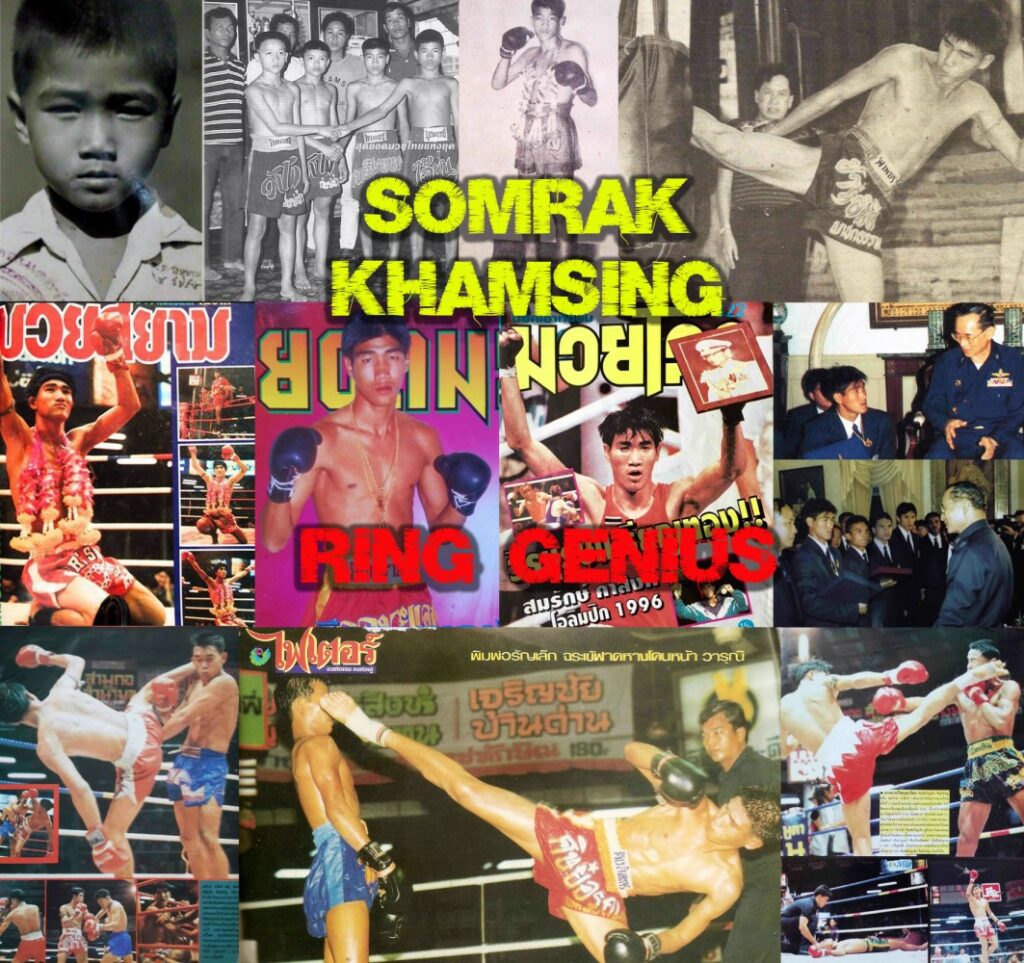
Somrak Khamsing was born on January 6, 1973, in Non Sombun, Khon Kaen Province, in northeastern Thailand.
Trained by his father, a former boxer, Somrak comes from a family of boxers. His older brother, Somrot Khamsing (Pimalan Leksitalat), was a great champion, ranking among the world’s best in his weight class in both Muay Thai and Boxing. He was an Asian champion and a quarter-finalist at the 1996 Atlanta Olympics.
Somrak had his first fight at the age of 7. He then trained at the Sor Kingstar camp in Khon Kaen, a camp that would later produce the legendary Saenchai.
At 11, Somrak joined the Sit Aran camp in Bangkok, a renowned facility that has trained champions such as Somrak, Pimthong, Tamrawee, and Jocky Sitkanpai. At that time, his fighting name was Pimaranlek Sit Aran. It was only later that he adopted the name Somrak Khamsing, when he took up boxing.
Subsequently, Somrak represented the famous Jocky Gym for several years before ending his Muay Thai career at the Kietpetch camp, run by Lumpinee Stadium promoter Chun Kietpetch.
Somrak remained number one at 126 lbs for a long time at both Lumpinee and Rajadamnern Stadiums, without ever having the opportunity to fight for a title in either of these prestigious stadiums.
Despite this, he defeated almost all the top champions of his era. Somrak Khamsing, sometimes called Somluck Khamsing, is today a true living legend in Thailand. His record is simply phenomenal, both in Muay Thai and boxing, with approximately 300 Muay Thai fights and 200 boxing fights. His Muay Thai techniques were spectacular, sometimes very similar to Muay Boran.
In Muay Thai, Somrak defeated the biggest names of his era, including Chamophet Ha Phalang, Chatchanoy Chaoayroy, Changnoi Sirimongkon, Kukrit Sor Nayiam, Sakmongkol Sitchuchok, Boonlay Sor Thanikul, Panomrung Sit Sowapor, Suwitlek Sor Sakaorat (KO), Anantasak Phayutaphum, and Namkabuan Nong Kee Pahuyuth.
In Boxing, he became the first Thai boxer to win an Olympic gold medal.
Like the great champion Samart Payakaroon, Somrak also tried his hand at acting and singing, which further boosted his popularity in his country.
Somrak then founded his own gym in the Bangkapi district, the Somrak Gym, also known as Thor Thepsuthin Gym.
Silachai Wor Preecha, whose real name is Somjit Jongjorhor, was born on January 19, 1975, in Noansuwan, Buriram Province, Thailand. An extremely fast fighter with his fists, Silachai was an exceptional Muay Mat (fighting specialist). He was nicknamed “The Tornado Kid.”
He began boxing at the age of 8 and fought in various stadiums in his hometown under the name “Kamsing Luk Kokrak.” Later, he followed an older neighbor, a boxer, to Chonburi Province. There, he joined the team of the renowned boxer Muangchon Jeeraphan, Wor Preecha’s trainer and promoter at Rajadamnern Stadium.
Silachai then fought under the name Silachai Wor Preecha in eastern Thailand, from Bang Pakong to Chanthaburi and Trat, more than 50 times, before settling in Bangkok. At the “Champion of Chonburi” tournament, organized by his mentor, he definitively earned the nickname “Tornado Kid.”
In Muay Thai, he was ranked number one at Lumpinee and Rajadamnern Stadiums in the 108 lbs weight class for an extended period, though he never had the opportunity to fight for a title. Silachai defeated many renowned champions, including Singhsumphan Kiatsinghnoi (twice), Panomrung Sit Sor War Por, Jaipetch Chor Chutisan, Pairojnoi Sor Siamchai, Samliam Singmanee, and many others.
He then transitioned to a career in Boxing.
At the 2008 Beijing Olympics, Silachai realized his dream by defeating Cuban Andris Hernandez in the final and winning the gold medal in the flyweight category (51 kg). He became an Olympic hero and an iconic figure in Thailand.
In 2003, at the final of the World Amateur Boxing Championships in Bangkok, he had already beaten Frenchman Jérôme Thomas, an Olympic silver medalist.
Today, Silachai is a commentator on various television programs and the head instructor at the I.M.P. Training Center of the International Muay Thai Academy. He is also a well-known actor, having played dozens of roles in Thai television series.

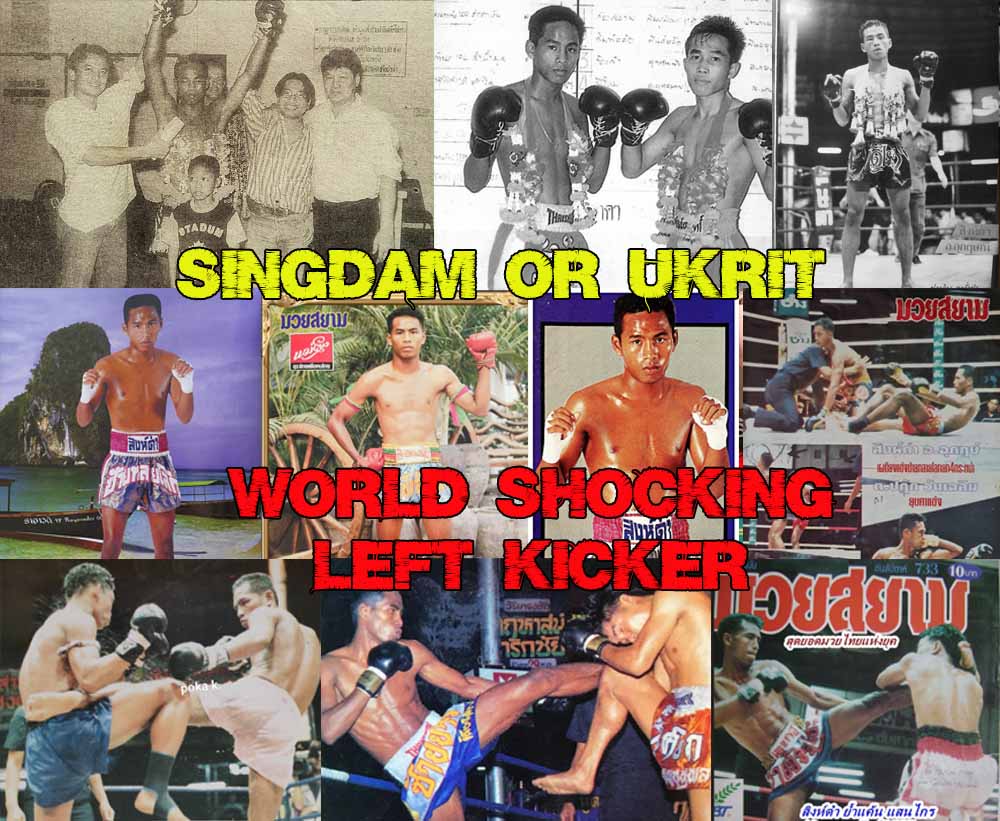
Singdam Or Ukrit, whose real name is Somboon Yangsuprayot, nicknamed Num, was born on November 11, 1974, in Amphoe Klaeng, Rayong Province. The sixth of eight children, he began training in Muay Thai at the age of nine under Kru Chan Fungfueng, his teacher and a former fighter from the Lueat Tawan Ok camp.
He fought around twenty bouts in his neighborhood under the name Saming Num Lueat Tawan Ok, before becoming Sing Num Sit Adam, thus building a solid reputation in his region.
His successes attracted the attention of Wichit Phaianan, a former Muay Thai champion of the 1970s and 1980s and a renowned trainer in eastern Vietnam at that time. Wichit then took him to train at the Luk Bang Plasroi camp, co-managed by Ukrit Tansawat, to fight under the new name “Singdam Or Ukrit.”
He made his debut in Bangkok under this name, knocking out the legendary Yokthai Sit Or (Lumpinee champion and WBA world boxing champion).
When he began fighting at Lumpinee Stadium, Singdam racked up 17 consecutive victories.
In 1992, Singdam faced the great Lumpinee champion Saenkrai Sit Kru Od, considered one of the best fighters of Muay Thai’s golden age. Their first encounter ended in a draw, before Singdam won the rematch.
That same year, he also defeated ring stars Yodkhunpol Sittraiphum (Lumpinee and Rajadamnern champion), nicknamed “Kran Sok 100 Khem” (the elbow with a hundred stitches), as well as the formidable Duangsompong Por Pongsawang, nicknamed “Khun Khao Kimlok” (the knee with the wire cutters).
Singdam then faced the best boxers in the under-54 kg category. His powerful and rapid left kick earned him the nickname “World Shocking Left Kicker.”
In less than a year, stars like Weeraphon Sahaprom (Rajadamnern champion, WBC and WBA world boxing champion), Samson Isaan (Rajadamnern and Lumpinee champion), Silapthai Jockygym (Rajadamnern champion), and Kaensak Sor Ploenchit (Rajadamnern and Lumpinee champion, Boxer of the Year in 1989 and 1990) all fell to him.
His fight against Kaensak Sor Ploenchit on Tuesday, July 13, 1993, was voted Match of the Year. At that time, Singdam was considered one of Thailand’s greatest bantamweight boxers, despite never having won the top title.
Singdam was then considered one of the greatest bantamweight boxers in Thailand, although he had never won the world title. He twice challenged Saenkrai Sit Kru Od for the Lumpinee Stadium 118 lbs title, but lost both times. In total, Singdam and Saenkrai faced each other seven times, with four wins for Singdam, two for Saenkrai, and one draw.
Singdam also defeated numerous champions, including Rotnarong Daopadriew (Rajadamnern Champion), Dokmaipa Por Pongsawang (Lumpinee Champion), Chutin Por Tawachai (Rajadamnern Champion), Sibmuen Laemthong (Lumpinee Champion), and Sila Tor Bangsaen (Omnoi Champion).
After retiring from boxing, Singdam married a woman from Chonburi Province, with whom he had two daughters. He then went to work as a trainer in Japan, before returning to Thailand where he became a municipal driver and opened a seafood stall in a market, while continuing to train Muay Thai fighters in various boxing camps.
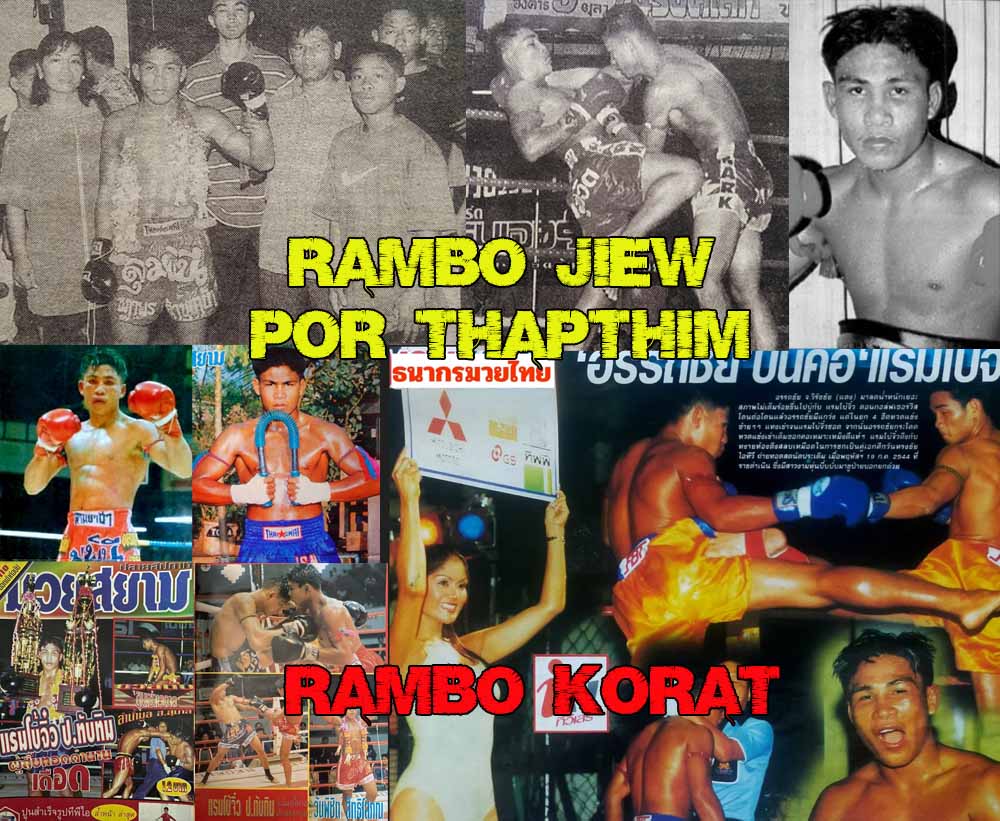
Rambo Jiew Por Thapthim, nicknamed “Rambo Korat,” was known for his aggressive and offensive style, which was very popular with the public. Born Prajak Baepkratok on April 27, 1978, in Tambon Lung Fao, Nong Bun Mak village, Nakhon Ratchasima province (also known as Korat), Rambo Jiew represented the Por Thapthim boxing camp, a renowned camp in Ban Nong Talumpuk, Nakhon Ratchasima province. He later fought under the name Rambo Jiew Don Golf Service.
His boxing style was impressive, featuring powerful punches, ferocious kicks, precise clinching, and effective knee strikes. He won the hearts of fans with his fighting spirit and exceptional stamina. He faced the greatest boxers of his era, such as Saenchai Sor Kingstar, Issarasak Jor Ratchadakorn, Aomnoi Sakseepung, Thedkiet Sithepitak, Namsaknoi Yutthakarnkamthorn and Samkor Kietmontep.
Rambo Jiew has defeated legends like Kaolan Kaowichit, Mattee Jedipitak, Chatchai Phaisithong, Wangchannoi Sor Palangchai and Lamnamoon Sor Sumalee, as well as champions such as Mitthai Sor Sakulphan, Huatapan Sor Sumalee, Nakornchai Chonlompinyon, Teelak Por Samranchai, Pichitsak Saksaengmanee, Daoudon Sor Suchat and Wanpichit Ruamjaiphuen. He also drew against icon Saenchai Sor Kingstar.
His fight against star Lamnamoon Sor Sumalee at Rajadamnern Stadium in 1997 was voted “Best Fight at Rajadamnern Stadium,” with Rambo Jiew winning by decision.
The rematch took place in 1999 at Lumpinee Stadium, with the Lumpinee 130-pound title on the line, and this time Lamnamoon Sor Sumalee emerged victorious.
In April 2000, Rambo Jiew had another shot at the top title, facing the reigning champion of the ring at the time, Samkor Kietmontep, who defeated him for the Lumpinee 130-pound belt.
Although he never won a title at a major Bangkok stadium, he did win one of the most prestigious tournaments of the era. On September 13, 1997, in the final of the third Mitsubishi Strada 130 lb tournament, Rambo Jiew defeated the formidable Singhasarawat 13 Coins Tower.
In the 2000s, he also faced top international champions such as Jean-Charles Skarbowsky (losing) and Morad Sari (winning).
After his boxing career, Rambo Jiew spent some time in a monastery as a monk, then became a farmer. Sadly, he succumbed to alcoholism and died of liver cancer in 2021.